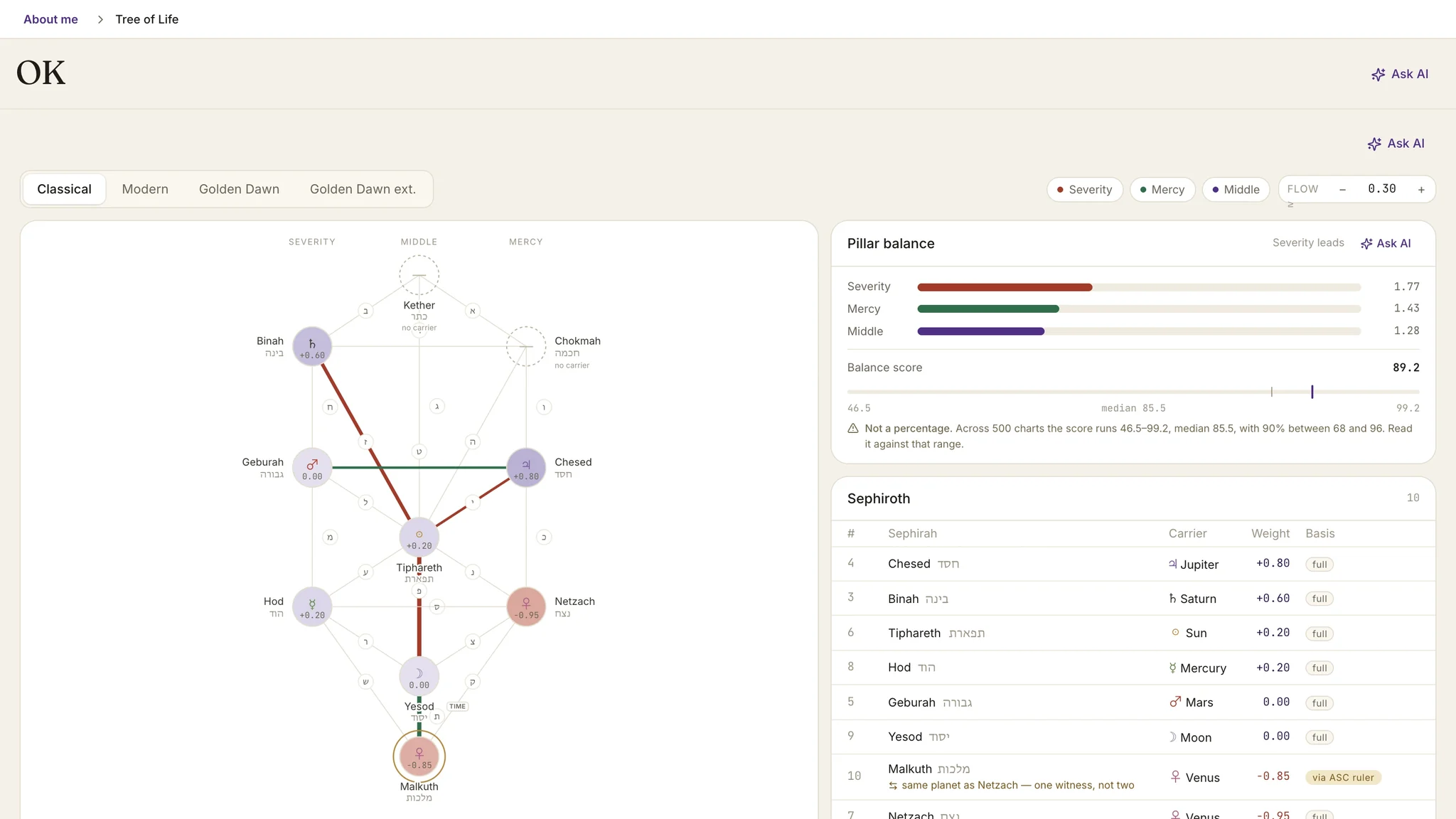
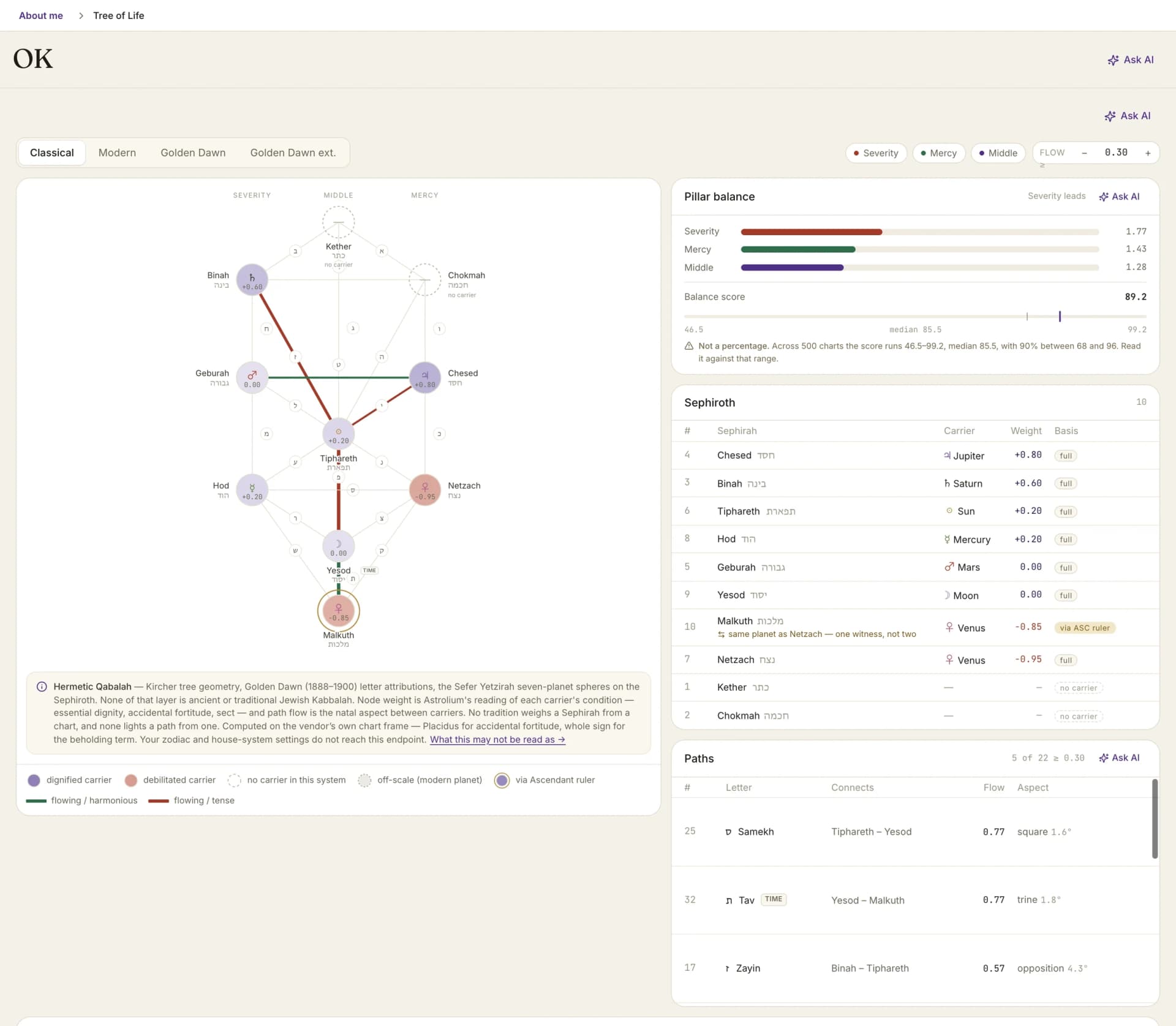
Astrolium computes a Tree of Life for one nativity: ten Sephiroth weighted by the condition of the planet carrying each one, twenty-two paths lit by the natal aspects between those carriers. Two people get different trees, which is the whole point.
The weighting draws on the same dignity and sect machinery as the essential dignities calculator and the natal chart workspace. For the classical background to sect and fortitude, the Hellenistic astrology guide is the place to start.
What the module actually computes
The usual complaint about kabbalistic astrology software is that it draws the same diagram every time. Ten spheres, twenty-two paths, a planet printed beside each sphere, and no connection to the chart of the person sitting across from you. This module puts the chart back in.
How a Sephirah gets its weight
Every Sephirah has a carrier, the planet assigned to it by the tree system you selected. The weight is that carrier's condition, and the detail panel breaks it into named components rather than a single opaque figure: essential dignity, accidental fortitude, sect, and the beholding term, with a total.
Two of those components come from different doctrines, and the module refuses to hide the seam. Accidental fortitude is computed on Placidus, the beholding term on whole signs. The provenance panel says so, and also warns that your own zodiac and house-system settings do not reach this calculation. That is an honest limitation, not a feature, and it is stated where you read the number.
Malkuth is a special case. It reads through the lord of the Ascendant, which may already carry another Sephirah. When that happens the table says so directly: if both rank high, that is one planet counted twice, not two testimonies.
Basis, and the four things a weight can be
Each Sephirah carries a basis label, which is the honest version of a confidence indicator.
- Full. A classical planet carries it and the full weighting applies.
- Via Ascendant ruler. The Malkuth case above.
- Off-scale. A modern planet carries it, so the number is not comparable to the classical seven and is excluded from the ranking and pillar means.
- No carrier. Nothing sits on this Sephirah under the current tree. Not a weight of zero. Nothing to weigh.
Switching between the 4 systems changes which of these applies. On the Classical tree, Kether and Chokmah carry no body at all.
The twenty-two paths
A path is lit by the natal aspect between the carriers at its two ends. The table gives the path number, its Hebrew letter, what it connects, the flow value and the aspect with its orb. The flow control raises or lowers the threshold, so you can start with everything and tighten until only the load-bearing contacts remain.
Two flags matter more than the rest. A path that ends on the Ascendant carries a time-sensitive flag, because the Ascendant advances by roughly 1 degree every four minutes of clock time, at a rate that depends on latitude and rising sign; an approximate birth time can reverse that path outright. A path with an outer planet at one end is flagged generational, since that end is shared by everyone born within months of the native. Where the other end is a fast body, that side stays personal.
Provenance, stated rather than implied
The panel names three things separately: the tree geometry received, the letter recension, and the carrier table. So a reading might report Kircher geometry, Golden Dawn letter attributions, and the Sefer Yetzirah seven-planet spheres on the Sephiroth. Where the response does not state its attribution, the panel says that too instead of filling the gap.
Two further disclosures sit in the detail view. The tarot attribution on a path is Golden Dawn, 1888 to 1900, not Sefer Yetzirah. And the weighting itself is Astrolium's reading, not a tradition: no tradition weighs a Sephirah from a chart, and none lights a path from one. Where a source labels an outer-planet placement with a famous name, the module treats that as the name of a table rather than as its authority.
What reading it is like
The tree renders under any of the 4 systems, with pillar filters for Severity, Mercy and Middle. Click a sphere, a path or any table row and the detail opens in place. The module never uses a popup or a modal, which sounds like a small thing until you have tried to compare two spheres in a tool that keeps covering the diagram.
Ask AI sends the ranked Sephiroth, the lit paths and their provenance, and asks for a reading of the whole Tree. You can also scope it to one Sephirah, one path, or the pillar balance.
For the tier detail see pricing, and for the self-use mode that includes this module see Astrolium Personal. If you want the underlying dignity arithmetic on its own, the essential dignities calculator is free.