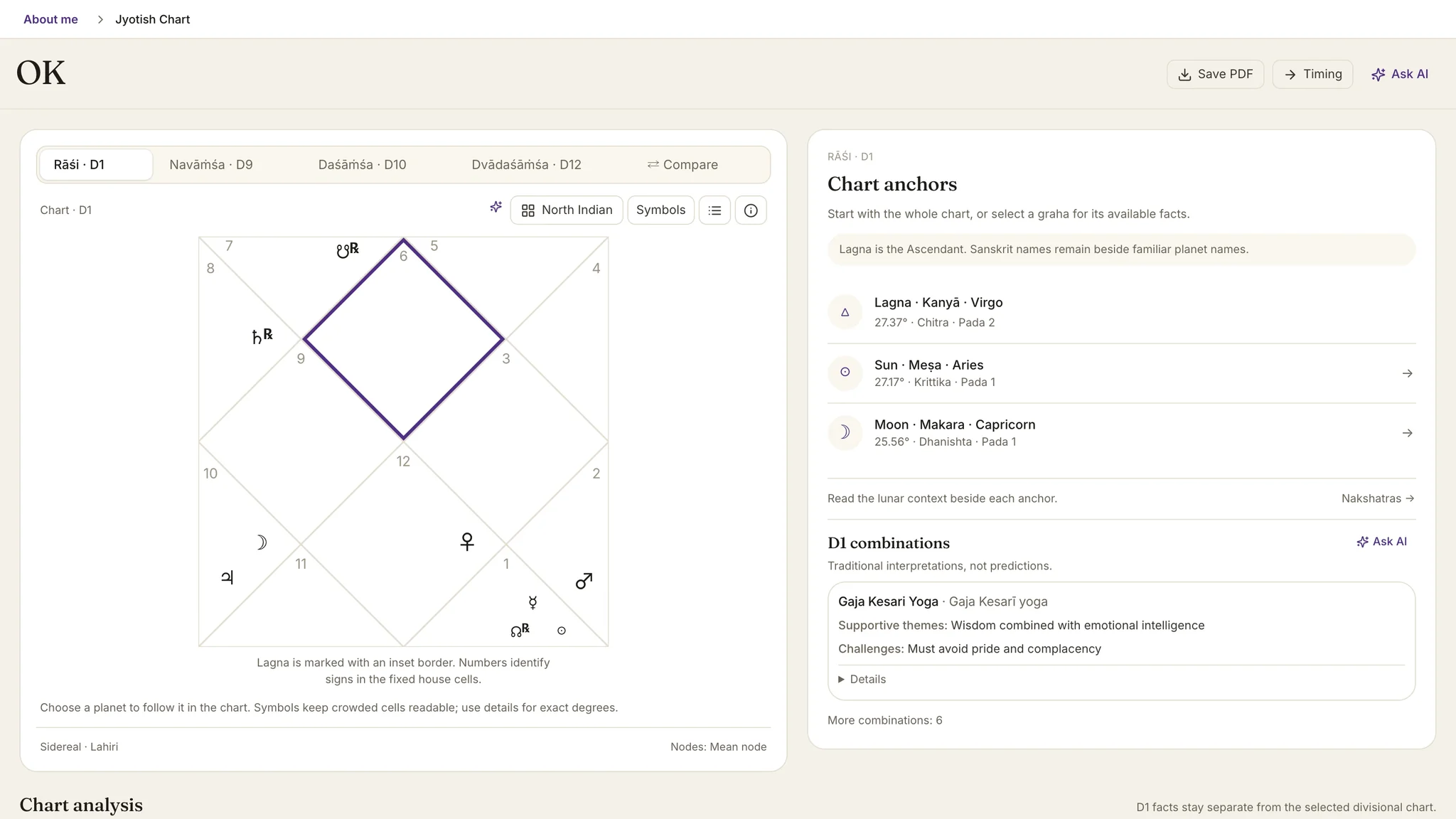
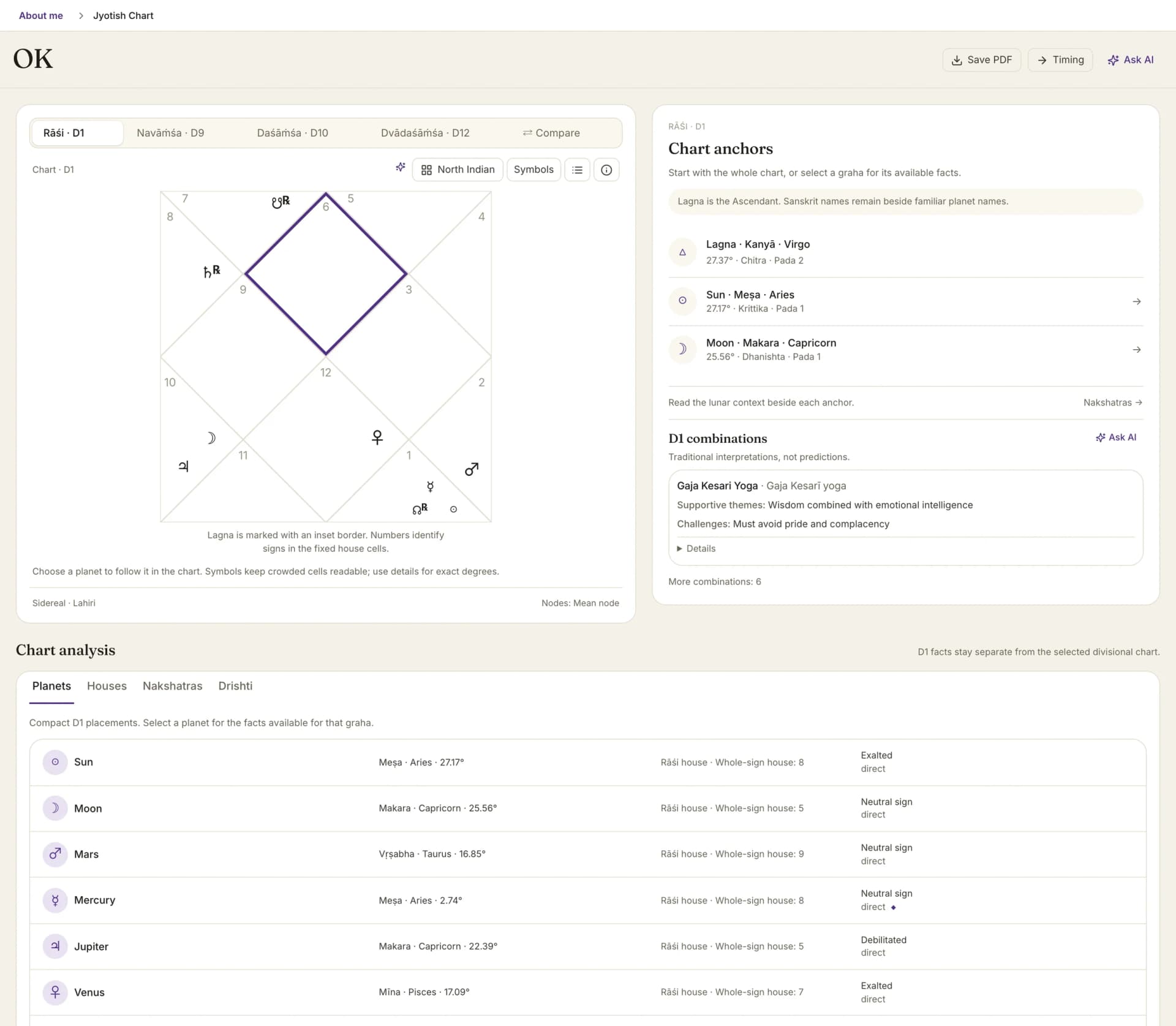
Astrolium casts a Parashari Kundli from the same client record as the natal chart, runs D9, D10 and D12 beside it, and moves to a three-level Vimshottari daśā and a Gochara table in one click. Sanskrit terms stay in front, with familiar planet names alongside them.
For a single free chart, run the Vedic birth chart calculator. For the technique itself, read the Vedic astrology guide. For Saturn's slow pass over the natal Moon as a standalone check, use the Sade Sati calculator.
What a Jyotish workspace holds
Jyotish carries its own vocabulary, its own house logic and its own timing system. A tropical chart rendered sidereally is not a Kundli, and most Western software stops at that trick. The two modules here were built as Jyotish rather than as a sidereal setting: the chart screen is called Kundli, the timing screen is called Daśā and Gochara, and the AI assistant is instructed to stay in Jyotish reasoning rather than translate placements into Western terms.
The chart screen
The D1 plate renders in either style. North Indian seats its houses on the Lagna in fixed cells with sign numbers; South Indian fixes the signs and numbers the houses. Select a graha and the panel fills with what the calculation can support for that body: rāśi, degree, whole-sign house, Bhāva house, nakshatra and pada, dignity, and the drishti it gives and receives.
Four analysis tabs sit under the wheel: Planets, Houses, Nakshatras, Drishti. The Drishti tab states its own scope, which matters more than it sounds. Graha Drishti is always computed on D1. Switch the wheel to Navāṁśa and the drishti panel does not follow, because the aspects belong to the Rāśi chart. Rahu and Ketu are shown receiving drishti but not giving it, per the Parashari method this release implements.
Chart combinations, the yogas, are listed as D1 combinations with supportive themes and challenges split apart. Each carries a provenance label: classical tradition, modern interpretation, or disputed interpretation. Neecha Bhanga cancellation is reported as present or not reported, never as a quiet assumption. The header on that section reads "traditional interpretations, not predictions", which is the honest register for the whole screen.
Vargas and the Compare view
D9 Navāṁśa, D10 Daśāṁśa and D12 Dvādaśāṁśa come from the same calculation. The switcher keeps the D1 facts pinned so you never read a varga position as though it were a Rāśi placement. Compare lays one graha across every divisional chart at once, which turns vargottama from a claim into something you can see in a column.
Timing: daśā, Gochara, Sade Sati
The Vimshottari cycle covers 120 years across nine lords. The sequence runs Mahādaśā, Antardaśā and Pratyantardaśā, with the balance at birth derived from the Moon's exact degree in its janma nakshatra. Charts sitting near a boundary get a specific warning: a birth time roughly so many minutes different would change the Mahādaśā lord. That is the kind of sentence a practitioner needs before quoting a date to a client.
Gochara is a table for the date you pick. Verdicts are counted from the natal Moon, and the from-Lagna column is labelled as house position only. Vedha is not applied, and the module says so rather than letting you assume it. "Not judged" means this table does not judge that house adversely, not that the transit is gentle. Aṣṭakavarga bindus appear only for the grahas the ephemeris vendor publishes them for; a dash means no count exists, not a zero.
Sade Sati is handled with its awkward parts intact. You get the window from first entry to final exit, the rising, peak and setting phases, and Saturn's retrograde re-entries spelled out as dates rather than smoothed into a tidy 7.5 years, Saturn spending about 2.5 years in each of the three rāśis. Kaṇṭaka Śani and Aṣṭama Śani appear as Dhaiyā labels when Saturn reaches the 4th or 8th from the Moon. If the natal Moon changes rāśi during the birth day and the recorded time is unreliable, no window is shown at all, with an explanation of what to ask the client.
What this release does not do
Being specific here is more useful than a feature list.
- One ayanamsha. Lahiri. No Krishnamurti, no Raman, no KP selector.
- Mean nodes only. True node is not offered in the Jyotish modules.
- No remedies. No gemstones, mantras or rituals, by product decision.
- No matching, dosha, panchang or muhurta inside the workspace.
- Bhāva Chalit is a labelled alternate column, equal from the Ascendant, not a second house system to read the chart in.
Astrolium's annual solar return can be solved sidereally, the precession-corrected convention Varshaphala practice uses; the Varshaphal calculator remains the free standalone route to a Tajik annual chart.
Free calculators, then the workspace
Nine free Vedic calculators live on this site, including the Vedic yoga calculator and the Vedic birth chart. They are single-shot: enter birth data, read an answer, close the tab. They call the ephemeris service directly and save nothing.
The workspace is the other half. A chart belongs to a client record, sits next to that client's Western charts, exports as a PDF, and feeds an AI assistant scoped to the facts on screen. For the broader picture of how a Jyotish chart reads, the Vedic astrology guide is the long-form companion, and pricing has the plan detail.