Astrolium tracks Uranian astrology as the most technically specific and most often dismissed of the 20th-century systems. The Hamburg School built its method around 3 things classical astrology either uses lightly or does not use at all: midpoints, the 90-degree dial, and 8 hypothetical planets whose existence as physical bodies has never been confirmed. Practitioners who work the system seriously, however, report precision in chart reading that the classical aspect grid does not match.
The system is small, demanding, and self-contained. Use the midpoint calculator to compute the personal midpoints (Sun/Moon, AC/MC) for any chart, then read the rest of this guide for the Hamburg method around them.
Uranian astrology, also called the Hamburg School, is the 20th-century natal system developed by Hamburg land surveyor Alfred Witte (1878 to 1941) and his collaborator Friedrich Sieggrun beginning around 1913. It reads charts through three technical elements classical astrology either uses lightly or omits entirely: midpoints (the degree halfway between two planets), the 90-degree dial (which compresses all hard aspects onto a single axis), and 8 hypothetical planets (Cupido, Hades, Zeus, Kronos, Apollon, Admetos, Vulkanus, Poseidon) derived empirically from chart patterns the known bodies did not explain. The unit of interpretation is the planetary picture: three points in midpoint relationship read as a compressed formulaic sentence. Witte-Verlag, founded 1925 by Ludwig Rudolph, remains the school's publisher. Reinhold Ebertin's Cosmobiology (1928 onward) kept the midpoint technique but dropped the hypotheticals. Astrolium's midpoint calculator computes personal midpoints like Sun/Moon and AC/MC from your natal chart.
Origins: Alfred Witte and the Hamburg School
Alfred Witte (1878-1941) was a Hamburg land surveyor and an amateur astrologer. His professional training was in geodesy: precise angular measurement of the earth's surface. The Uranian method's reliance on exact midpoints and the 90-degree dial reflects that background directly. Witte began his astrological work around 1913 and published the first iteration of his system through the 1920s.
The institutional structure came in 1925, when Ludwig Rudolph founded Witte-Verlag in Hamburg as the school's publisher. Rudolph's son and grandchildren still run the press; Rules for Planetary Pictures (Witte's primary text) has been continuously in print there since the late 1920s. Friedrich Sieggrun (1877-1951) joined Witte as the main collaborator, adding 4 of the hypothetical planets to Witte's original 4.
The Nazi regime suppressed astrology generally from 1933 onward, and the Hamburg School specifically because of its publishing visibility. Witte was forbidden to publish from the late 1930s. He died by suicide in 1941, by most accounts in connection with the suppression and the broader political pressure on Hamburg's intellectual culture. The school survived through Rudolph's continued private printing and through students who carried the manuscripts to the United States and Latin America.
After WWII, the school rebuilt in two directions. Reinhold Ebertin (1901-1988) had developed a stripped-down variant called Cosmobiology beginning in 1928. Ebertin kept the midpoint technique and the 90-degree dial but dropped the hypothetical planets, arguing they could not be empirically defended. His The Combination of Stellar Influences (German: Kombination der Gestirneinflüsse), first published in 1940 and translated into English in 1972, is the standard Cosmobiology reference and the most cited midpoint book in English-language practice. The full Hamburg School with hypotheticals continued in parallel, carried in the United States by Hans Niggemann and later Penelope Bertrand, and in Germany by the Rudolph family and the Brummund circle.
The school today is small. Most working astrologers know it through Ebertin's COSI rather than through Witte directly. The full Hamburg method has perhaps a few hundred trained practitioners worldwide.
The 8 hypothetical planets
The 8 Uranian bodies were derived empirically by Witte and Sieggrun: they observed chart patterns that the known planets did not explain, calculated positions that would account for the patterns, and published the resulting points as planets. Modern astronomy has not confirmed any object at the published positions. The Hamburg School treats them as working calculations regardless, the way mathematicians treat imaginary numbers: useful whether or not they correspond to observable bodies.
The 4 Witte planets (introduced 1920s):
- Cupido. Family, art, the small group, alliance, marriage as social form. Closer to the older Greek Eros than to a romantic principle. Read at the intersection of relating and structure.
- Hades. Things hidden, decay, archaeology, the underground, illness, the long past. The dredged-up material. Often shows in charts connected to medicine, historical work, or excavation.
- Zeus. Production, ignition, controlled energy, machinery, fire under management. The principle of directed force. Active in charts of engineers, military officers, and industrial work.
- Kronos. Authority, mastery, executive function, the highest competence in a field, government. Not Saturn-as-restriction but Saturn-as-mastery. Active in charts of senior leaders.
The 4 Sieggrun planets (introduced 1920s and 1930s):
- Apollon. Expansion, success, broad reach, multiple connections, commerce on scale. The principle of widening.
- Admetos. Persistence, focus, depth, narrowing, raw materials, stuck conditions. The principle of holding to one thing.
- Vulkanus. Power, force, intensity, the capacity to override. Distinct from Mars (assertion) and Pluto (transformation). Active where sheer strength is the operative factor.
- Poseidon. Spirit, ideology, transcendent thought, illumination. The principle of mind beyond physical reference. Active in charts of mystics, theorists, and ideologues.
The 8 bodies are calculated by Witte's empirical ephemerides, distributed by Witte-Verlag and integrated into most professional astrology software. Their positions are deterministic; any program with the Hamburg ephemerides will produce identical results.
Midpoint trees and planetary pictures
The midpoint technique is the methodological core of the system, more central than the hypotheticals.
A midpoint between two planets is the degree exactly halfway between them on the zodiac. The midpoint of a Sun at 10° Leo and a Moon at 20° Libra is 0° Virgo: the half-sum. The notation is Sun/Moon, read as "Sun over Moon."
The midpoint of two planets is read as a sensitive point in the chart that carries the combined meaning of the two. The Sun/Moon midpoint is the personality midpoint, the single most-cited point in Hamburg practice: it represents the integration of the conscious self (Sun) and the felt self (Moon) into the working identity. Any planet within roughly 1 degree of the Sun/Moon midpoint activates that personality core.
A midpoint tree is the full list of every midpoint axis within orb of a given chart point. The tree for a natal Venus, for example, lists every pair of planets whose midpoint falls within 1 degree of Venus. Each entry is read as a planetary picture: 3 points in active relationship.
A planetary picture is the unit of Uranian interpretation. Three points in midpoint relationship form a sentence. Saturn = Venus/Mars is read as "Saturn at the midpoint of Venus and Mars": restriction in the relating-and-assertion field, often shown as inhibition in sexual expression or in the timing of partnership decisions. The pictures are short, sharp, and formulaic. Witte's Rules for Planetary Pictures lists hundreds of standard combinations with their interpretations.
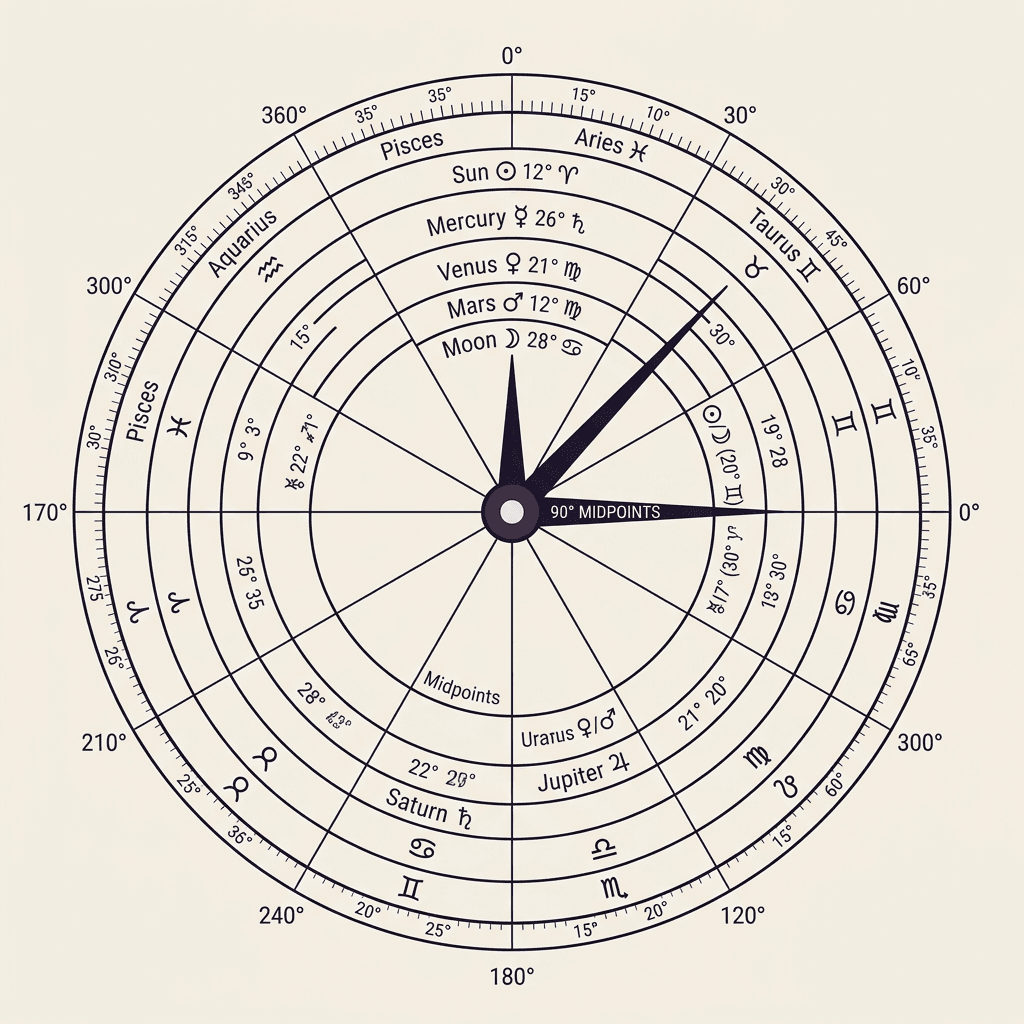
The 90-degree dial is the workhorse tool. The standard 360-degree wheel is compressed to 90 degrees, with all hard aspects (conjunction, square, opposition) falling on the same axis. The dial is rotated to bring each personal point in turn to the top; everything within 1-2 degrees on the dial is then in hard aspect to that point. The technique surfaces midpoint trees rapidly and visually, in a way the 360-degree wheel cannot. Computer software replicates the dial in 2 clicks; pre-computer Hamburg practice used physical cardboard dials.
How does Uranian differ from other astrology systems
Versus psychological astrology. Uranian readings are short, formulaic, and sharp. A picture like Saturn = Sun/Moon is read as "obstruction or limitation to the personality integration"; the psychological version of the same configuration would run 3 paragraphs. The Hamburg School is not narrative. Its practitioners report that the formulaic style is the source of the system's precision, not a limitation of it.
Versus traditional astrology. Hellenistic and medieval practice are aspect-led: planet to planet, weighted by orb, sign, and house. Uranian practice is midpoint-led: planet to midpoint of 2 other planets, on the 90-degree dial, with house position read separately. The Hamburg School uses Meridian or Campanus houses where it uses houses at all; the topical work is mostly done through the midpoint pictures themselves rather than through house placement.
Versus evolutionary astrology. The Hamburg method describes the present moment with high precision. It does not work across lifetimes; the system has no native concept of soul, karma, or prior incarnation. A Uranian reading and an evolutionary reading of the same chart will produce non-overlapping information: the Hamburg picture says what is active now, the evolutionary reading says what soul work is being done.
Versus Cosmobiology. Ebertin's variant is the most-used midpoint system in English-language practice, partly because Ebertin published in German and got translated where Witte did not. Cosmobiology keeps everything the Hamburg School does except the 8 hypotheticals. A Cosmobiologist will read Saturn = Sun/Moon the same way a Hamburg practitioner does; they will differ only on whether to include, say, Hades = Sun/Moon as an additional layer.
How do practitioners read a Uranian chart
The standard procedure used by trained Hamburg practitioners:
Step 1. Set up the 90-degree dial with the natal positions. Software handles this in 2 clicks; manual setup takes 10-15 minutes.
Step 2. Identify the personal points: Ascendant, Midheaven, Sun, Moon, Mercury, Venus, Mars. The Aries Point (0° Aries) is also treated as a personal point in Hamburg practice, representing the connection to the wider world.
Step 3. Compute the primary personal midpoints: Sun/Moon, AC/MC, Moon/Mars, Venus/Mars, Sun/Saturn. These are the most-cited integration points.
Step 4. Walk the midpoint tree from each personal point in turn. List every midpoint axis within 1 degree (some practitioners use 1.5 or 2 degrees for a fuller tree). Each entry is a planetary picture.
Step 5. Add hypotheticals as the reading requires. For a question about authority and career, bring in Kronos. For hidden material, Hades. For ideology and belief, Poseidon. Practitioners disagree on whether to include all 8 hypotheticals routinely or only when the question calls for them.
Step 6. Read transits and progressions to the dial directly. Transiting Saturn within 1 degree of a natal personal midpoint activates the picture that midpoint represents. The dial makes this trivial to see; the standard wheel does not.
Run the midpoint calculator for the personal midpoints in any chart in 30 seconds. The harmonic chart calculator handles related advanced work for practitioners who combine Hamburg-style midpoint work with harmonic analysis.
Working examples of planetary pictures
A short sample of standard pictures, drawn from Witte's Rules and Ebertin's COSI, with their interpretations. The format is anchor planet = midpoint:
Saturn = Sun/Moon. Restriction or limitation on the personality integration. In an event chart, an obstruction to a marriage or partnership. In a natal chart, the felt sense that the conscious and felt self do not meet without effort.
Mars = Mercury/Saturn. Sharp, structured thinking; sometimes harsh speech. Ebertin's reading includes engineering and technical analysis as fields where the picture supports the work.
Venus = Sun/Mars. Pleasure or beauty in the integration of self and assertion. Often shows in charts of performers, athletes who present aesthetically, or partners who fit into the native's drive without conflict.
Jupiter = MC/AC. Expansion at the meeting of public role and private self. The midpoint of MC and AC is read as the personality's outer profile; Jupiter there names the native as broadly visible, optimistic, or well-positioned for recognition.
Pluto = Sun/Moon. A heavy or transformative force on the personality. Both natal and event charts read this as material that cannot stay surface-level; the conscious and felt self are reworked by something the native cannot easily control.
Kronos = Sun/MC. Authority on the identity-and-public-role axis. One of the more frequently cited hypothetical pictures: shows in charts of senior executives, government figures, and others who carry external authority as a personal signature.
Hades = Mercury/Saturn. Dark or hidden material in the structured-thought field. Witte's reading includes research into the past, archaeology, and the kind of investigative work that depends on uncovering what has been buried.
These pictures are read combinatorially. A chart with both Saturn = Sun/Moon and Hades = Mercury/Saturn carries restriction in the personality and dark structural material in the thinking; the practitioner reads both into a coherent picture rather than treating them as separate signals.
Why does the Hamburg School remain marginal in modern practice
Uranian astrology has never reached the practitioner numbers of the psychological, evolutionary, or traditional schools. The reasons are partly historical, partly methodological.
The Nazi suppression of the late 1930s broke the school's institutional growth at exactly the moment the psychological and evolutionary schools were establishing themselves in the United States. Witte died in 1941; the school's center of gravity moved to small surviving circles in Hamburg and to the immigrant carriers in the Americas. The school never regained the publishing reach it had in the 1920s.
The methodological cost is real. The full Hamburg system requires fluency with the 90-degree dial, comfort with 8 additional bodies whose ephemerides change subtly between editions, and a willingness to read in formulaic 3-point pictures rather than narratively. The training curve is steeper than for psychological astrology, where the vocabulary maps directly onto everyday English. Most contemporary practitioners encounter the midpoint technique through Ebertin and stop there; the 8 hypotheticals stay foreign.
The school's defenders argue that the marginal status is not a verdict on the method. The Hamburg practitioners who do the full work report consistently high precision on event timing and on natal interpretation; the system's compactness is what produces the precision. Whether the 8 hypothetical bodies are "real" in any astronomical sense is, in this view, beside the point: they work as calculated reference points in the same way the midpoints themselves work, and the proof is in the chart reading.
For practitioners who want to evaluate the system, the standard entry path is to learn the midpoint technique through Ebertin first, work the personal midpoints (Sun/Moon, AC/MC, Venus/Mars) for a few months on charts you already know well, and only then add the hypotheticals one at a time. Kronos and Hades are typically the first two added; the full 8 take a year or more to integrate.
Recommended reading
The primary sources, in order of usefulness for a practitioner building a working foundation:
- Alfred Witte, Rules for Planetary Pictures (Witte-Verlag, continuously in print since the late 1920s). The founding text. English translations of varying quality exist; the Witte-Verlag German edition is the reference. Read this for the picture interpretations; the methodology is laid out in compressed form.
- Reinhold Ebertin, The Combination of Stellar Influences (COSI) (1940; English translation 1972). The standard midpoint reference in English. Most working midpoint astrologers use COSI rather than Witte directly. Ebertin's interpretations are crisp and clinical.
- Penelope Bertrand, contemporary writing through the Uranian Astrologer website and journal articles. The most prominent English-language carrier of the full Hamburg method in the 2020s.
- Brummund and Rudolph, contemporary German Uranian work published through Witte-Verlag. Less translated, more rigorous, the closest living continuation of the original school.
- Michael Munkasey, Midpoints: Unleashing the Power of the Planets (1991). Modern English-language reference that catalogues midpoint interpretations across many sources, including both Hamburg and Cosmobiology readings.
For practitioners new to the method, COSI is the standard entry. For the full Hamburg system with hypotheticals, Witte's Rules in German with a competent translator is unavoidable; the partial English translations skip too much. The Witte-Verlag site stocks the ephemerides for the 8 hypothetical bodies if your software does not include them.
For a contrast with a school that uses the same outer-planet weight in a very different way, see evolutionary astrology. For the depth-psychological approach the Hamburg School deliberately does not take, see psychological astrology. Working Uranian practitioners often pair the radix midpoints with the asteroid calculator for Ceres, Pallas, Juno, and Vesta, and with the midheaven calculator for sharper MC dial work. The heliocentric chart tool is also part of the Hamburg toolset for tracking long-cycle outer-planet timing without the lunar wobble.